


Keeping Your Poinsettia Year-Round: A Care Guide
The poinsettia is one of the most popular festive symbols. Its vibrant, lovely colour brightens the Canadian houses, which are cold and dark in the winter. Many people use this tropical plant merely as a decorative item and throw it away after the Christmas display is over.
Nevertheless, poinsettia (Euphorbia pulcherrima) is actually a thorny shrub. You can very well keep it in proper health and make it grow all year. If you follow a specific schedule, you can even get it to flower again next year.
This guide is a tremendous help in understanding the four life stages of the plant: winter stability, spring recovery, summer growth, and autumn preparation. Mastering this plant means you have the right knowledge and skills to handle these transitions.
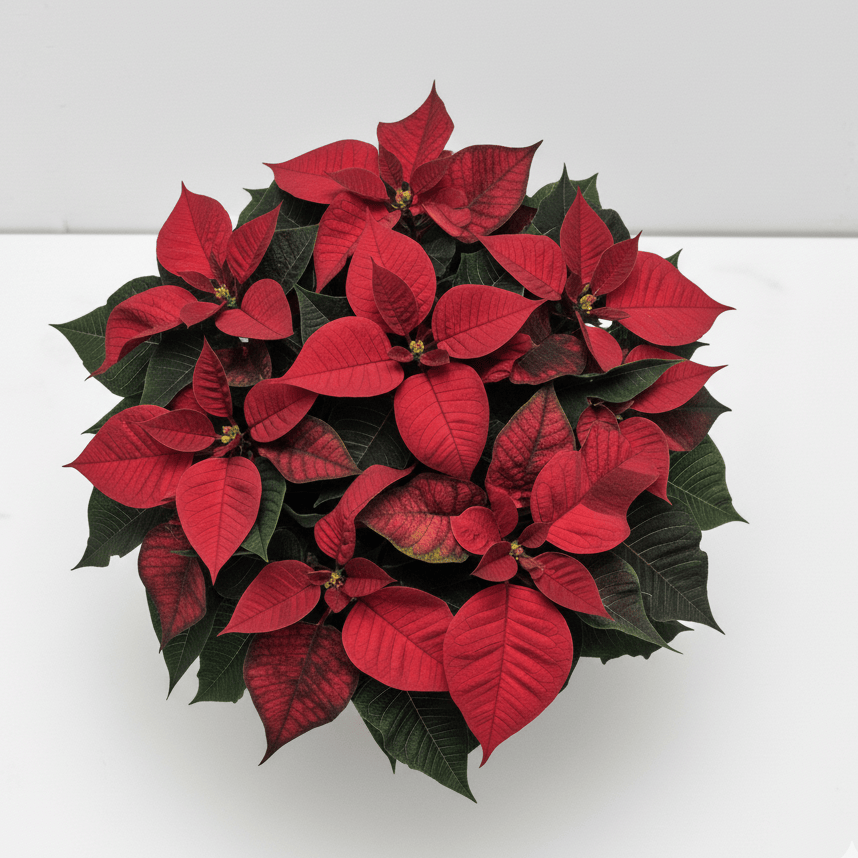
Phase 1: Winter Survival and Stability (December to February)
The period immediately after you bring home your new plant is crucial to its health. First and foremost, the poinsettia is a plant that needs stability. To keep the plant alive in the house, it is necessary to maintain a constant warm temperature and carefully check the moisture level of its medium.
Temperature and Cold Protection
It must be emphasized that poinsettias are highly vulnerable to cold. Being a tropical plant, it is definitely among the most sensitive, and hence, if the temperature drops below 10°C (50°F), it will suffer greatly, even for a brief time. This condition is called chilling injury. To keep it safe, make sure the pot is fully wrapped before leaving the store.
Please ensure it is taken home or to a warm place at your earliest convenience. Once the plant is indoors, it should be kept in a room at a stable temperature. The best range is 18°C to 24°C (65°F to 75°F). Make sure the plant is free from drafts of cold air. Don't put it near any exterior doors or heating vents.
Light and Location
Your poinsettia must have access to plenty of light to keep its bright colour. Light should be indirect, meaning the plant should not be left in direct sunlight. A window facing south, east, or west is almost always the best place.
If the plant is deprived of light, the lower leaves will soon turn yellow and fall off. At the same time, be sure the leaves do not come into direct contact with the window glass, which might be cold.
Watering Without Overdoing It
The quickest way to destroy an indoor poinsettia is to overwater it. The soil must be kept at a moderate moisture level, but it should never be saturated. If the roots are planted in water, they will rot.
Water the plant only when the top two centimetres (one inch) of soil are completely dry in your hand. Water should be at room temperature. Water gradually until it starts to drip from the bottom of the pot.
Any water that remains in the saucer or the decorative foil must be poured out immediately. It is not allowed to place a pot in a container of water.
Phase 2: Spring Recovery and Pruning (March to May)
After the holidays, when the plant's bright colour begins to fade, it is time to activate its recovery mode. Part of the early spring stage is also immediate pruning and soil management.
Pruning and Repotting
After the colour show, which is usually in late March or early April, a drastic cut of the plant is in order. This helps the plant to generate new, vigorous growth. All green stems should be cut.
Something like 10 to 15 centimetres (4 to 6 inches) of the stem left above the ground is enough. Make your cut just above a clearly visible leaf bud. If you come in contact with the plant's white sap while pruning, it can irritate your skin.
After pruning, make a check of the plant’s roots. If roots are circling inside the pot, repot the plant in a container that is not much bigger than the previous one, filled with fresh, high-quality, well-draining potting mix.
Starting Fertilization
The plant temporarily stores energy while in bloom. As new growth pops up in spring, the plant is asking for food. Now is the ideal time to initiate fertilization. A balanced, water-soluble fertilizer for houseplants is the product to be used.
The fertilizer should be mixed at half the strength recommended on the label. The plant is to be fed every two weeks throughout the spring and summer period.
Phase 3: Summer Growth and Shaping (June to August)
The summer period is the time to focus on strengthening the robust growth that will occur later. Having a healthy, wide structure now means the plant will have many colourful bracts later in the year.
Outdoor Placement and Pinching
The moment when outdoor placement of your poinsettia is possible is when there is absolutely no danger of frost and the temperature at night is above 12°C (55°F) for a couple of days in a row. Find a location that receives morning sunlight for at least a few hours but is shaded during the extremely hot afternoon.
If you want a bushy plant, you have to pinch the stems. Pinching is cutting off the top growing tip. Thus, the side buds are forced to activate and grow outward.
You should start pinching the top inch of new growth in early June. You should do this again every four to six weeks. You are obliged to stop all pinching and trimming by mid- to late August. This is very important so that the branches can mature before the next step.
Phase 4: Rebloom Preparation (September to November)
The biggest challenge, but also the most rewarding, is getting the poinsettia to colour up again. Poinsettias are short-day plants. They need long periods of darkness during which the colour change occurs.
The Absolute Darkness Schedule
The plant must be deceived into thinking that the coming season is winter. This is the indicator that actually triggers the blooming process. The darkness routine has to start approximately at the end of September or in the first week of October. The plant should be brought back indoors first.
The daily schedule calls for absolute, complete darkness for 13 to 15 hours every single night, with no light whatsoever, even for a moment. In other words, the plant must be placed in a pitch-black space such as a closet or a box, from about 5 pm until 8 am the next day.
During the remaining 9 to 11 hours of the day, the plant should be placed in a location with bright light but no direct sun. You must be really strict about this schedule for six to eight weeks in a row. During that time, you should stop all fertilizing.

Enjoying the Rebloom
The moment when the leaves start changing colour, usually late November or early December, is when the nightly covering of the plant can be stopped. The poinsettia should then be placed in a bright spot, which will be its final spot during the holidays.
Frequently Asked Questions (FAQs)
1. Are poinsettias a harmful factor for people or pets?
The popular notion that poinsettias are extremely poisonous is mostly a myth. The plant is considered mildly toxic, not lethal. If a pet or person consumes the leaves or bracts, minor upset stomach and vomiting may occur. The white sap on the stems can cause a slight rash if it comes into contact with the skin. It is always safest to keep all houseplants out of the reach of children and pets.
2. Why are the leaves on my poinsettia yellow and falling off?
The dropping of leaves is a sign that the plant is suffering from stress, usually caused by being in a too-cold place or improper watering. If the leaves are yellow and the soil is wet, it suggests you are overwatering, which can lead to root rot. If the leaves and the soil are dry, the plant is simply too dry. If leaves are shedding rapidly on a healthy plant, it is most likely due to cold damage from a draft or to the plant being too close to a cold window.
3. How can I make my poinsettia turn red again for next Christmas?
Making the plant flower again requires starting a strict light cycle around October 1st. The plant demands 13 to 15 hours of total, absolute darkness every night. No darkness can be interrupted. During the day, the plant needs to be kept in bright light. The exact schedule should be adhered to for six to eight weeks until a new colour appears.
4. When should I start fertilizing my poinsettia?
Fertilizing should not be done on a poinsettia that is blooming during the holidays. Only after the plant enters the active growth phase in spring should fertilization be initiated. The right time to start feeding the plant is when it is pruned in March or April, followed by the appearance of new green growth. Balanced houseplant fertilizer at half the recommended dosage should be used every two weeks during spring and summer.
5. What am I to do with my poinsettia when the bracts begin to fade?
When the colours fade after the holidays, it's time to let the plant rest. Watering should be done less often than before. The plant should be kept in a bright, stable place. Prune all the stems back to about 10-15 cm (4-6 inches) sharply in early spring (March or April). Repot if the plant is root-bound. Once pruning is complete, regular watering can resume, and summer growth can be encouraged by fertilizing.
